
A Melbourne business decides to print 1,000 postcards for a local offer, an event, a product launch, or a customer follow-up. The card looks simple on screen, but the practical decisions arrive quickly: size, stock, finish, address area, writable space, offer code, mailing list, delivery timing, and whether the piece will go through Australia Post.
Postcard printing works best when the format, message, production method, mailing plan, and tracking method are decided together before the design is final. At Elgin Printing, our Carlton print facility often checks these details before production so the job is not forced into late artwork changes.
A postcard should feel simple to the person receiving it. That simplicity usually comes from making the print decisions early.
Postcard printing is not one format with one purpose. The same card shape can work as a local promotion, event invitation, appointment reminder, product insert, real estate update, customer thank-you card, or direct mail follow-up. The right format depends on the job the card needs to do.
A postcard for a letterbox campaign usually needs a bold message, clear offer, and fast response path. A thank-you card needs space for a handwritten note. A product insert needs to sit inside packaging without feeling oversized. A real estate card needs local relevance, recent activity, and easy contact details.
| Campaign purpose | Best postcard approach | Why |
|---|---|---|
| Local promotion | Bold offer, clear expiry date, direct call to action | The offer needs to be understood quickly |
| Event invitation | Strong image, date, time, location, and RSVP details | The practical details need to be easy to scan |
| Real estate update | Suburb-specific message, agent details, and recent activity | Local relevance gives the card a reason to be kept |
| Thank-you card | Writable reverse side and a softer stock feel | A personal note needs usable writing space |
| Product insert | Small format with brand image, care note, or discount | The card needs to work inside the package |
For custom postcards, the useful question is not only what will fit on the card. It is what the card needs the recipient to do next: book, call, scan, RSVP, visit, redeem, remember, or keep.
Postcard size affects design, handling, postage, and cost. A6 and DL are common campaign sizes because they give enough room for an offer and image without becoming hard to handle. Square or custom cards can work well for brand-led campaigns, but they need a postage check before artwork is locked.
Our standard postcard sizes include A6 at 105 x 148 mm, DL at 99 x 210 mm, and square or custom sizes on request. A6 is compact and familiar. DL gives more horizontal space for a longer offer, voucher, or address panel.
Australia Post currently lists a small letter or postcard within Australia as up to 250 g, with a maximum size of 130 x 240 x 5 mm and a price of $1.70. A6 and DL can sit within that size limit, but the mailing method still needs to be checked. Thickness, weight, shape, address placement, barcode needs, and campaign volume can all change the right postal option.
| Size | Typical use | Mailing note |
|---|---|---|
| A6, 105 x 148 mm | Offers, event cards, product inserts, appointment reminders | Compact and usually cost-effective |
| DL, 99 x 210 mm | Letterbox campaigns, longer offers, vouchers, real estate updates | More room for copy while still fitting many mailing plans |
| Square or custom | Brand-led cards, higher-finish invitations, keepsake pieces | Check mailing rules before committing to the format |
When checking postcard dimensions in Australia, size is only part of the decision. A card that fits the maximum dimensions may still need layout changes for the address area, return address, postage mark, barcode, or mailhouse processing.
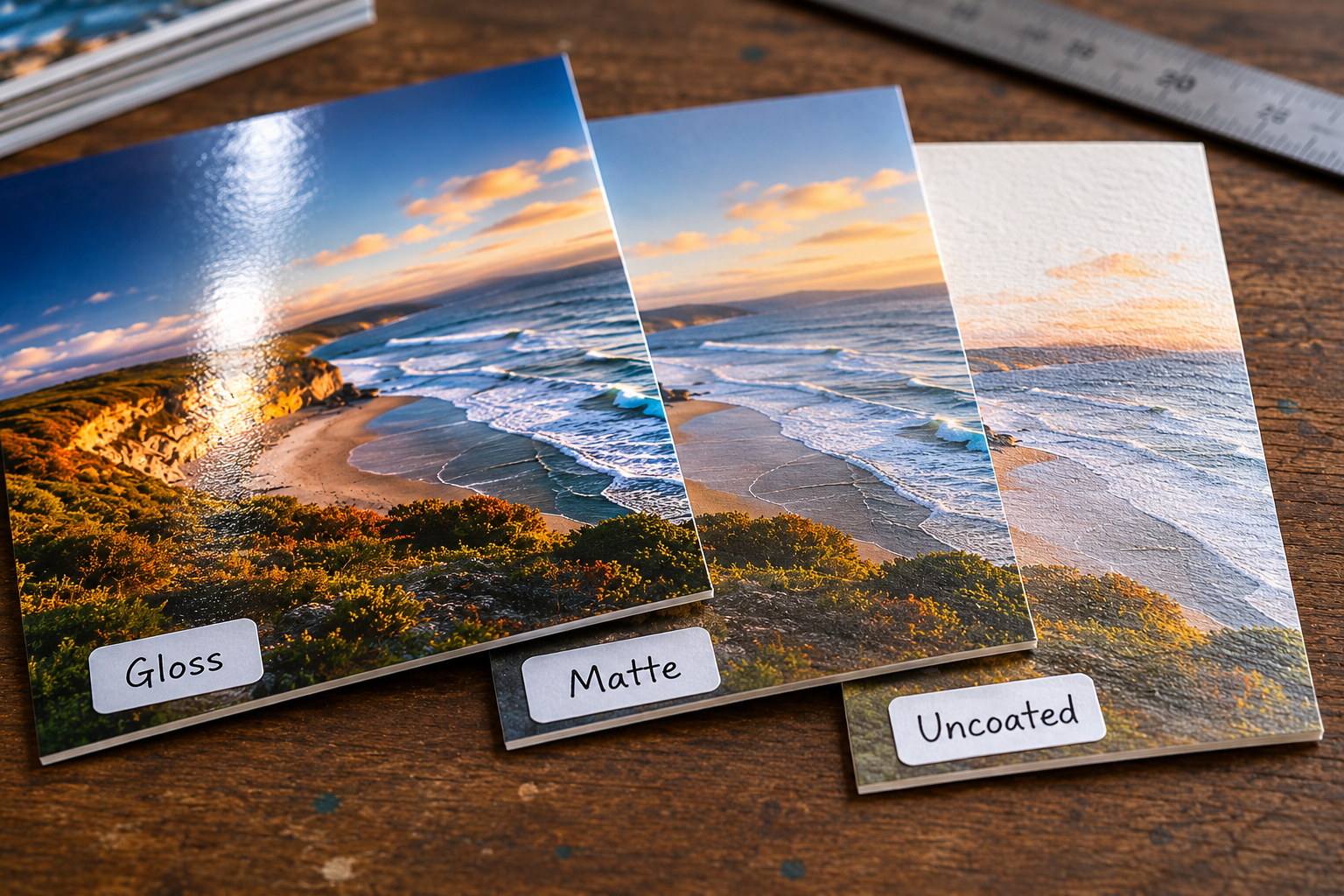
Postcard stock and finish affect how the card handles, how it photographs, how it travels through the mail, and whether anyone can write on it. The decision should match the campaign, not just the design.
Our postcard options include 350 gsm or 400 gsm stock, gloss, matte, or uncoated finishes, single-sided or double-sided printing, and a writable surface on one side where needed. Rounded corners, spot UV, and soft-touch finishes can also be discussed for custom work.
The practical trade-offs are clear:
For postcards that will be written on by hand, the writable side should be planned from the start. It is not enough to leave a blank area if the finish makes the surface difficult to use.
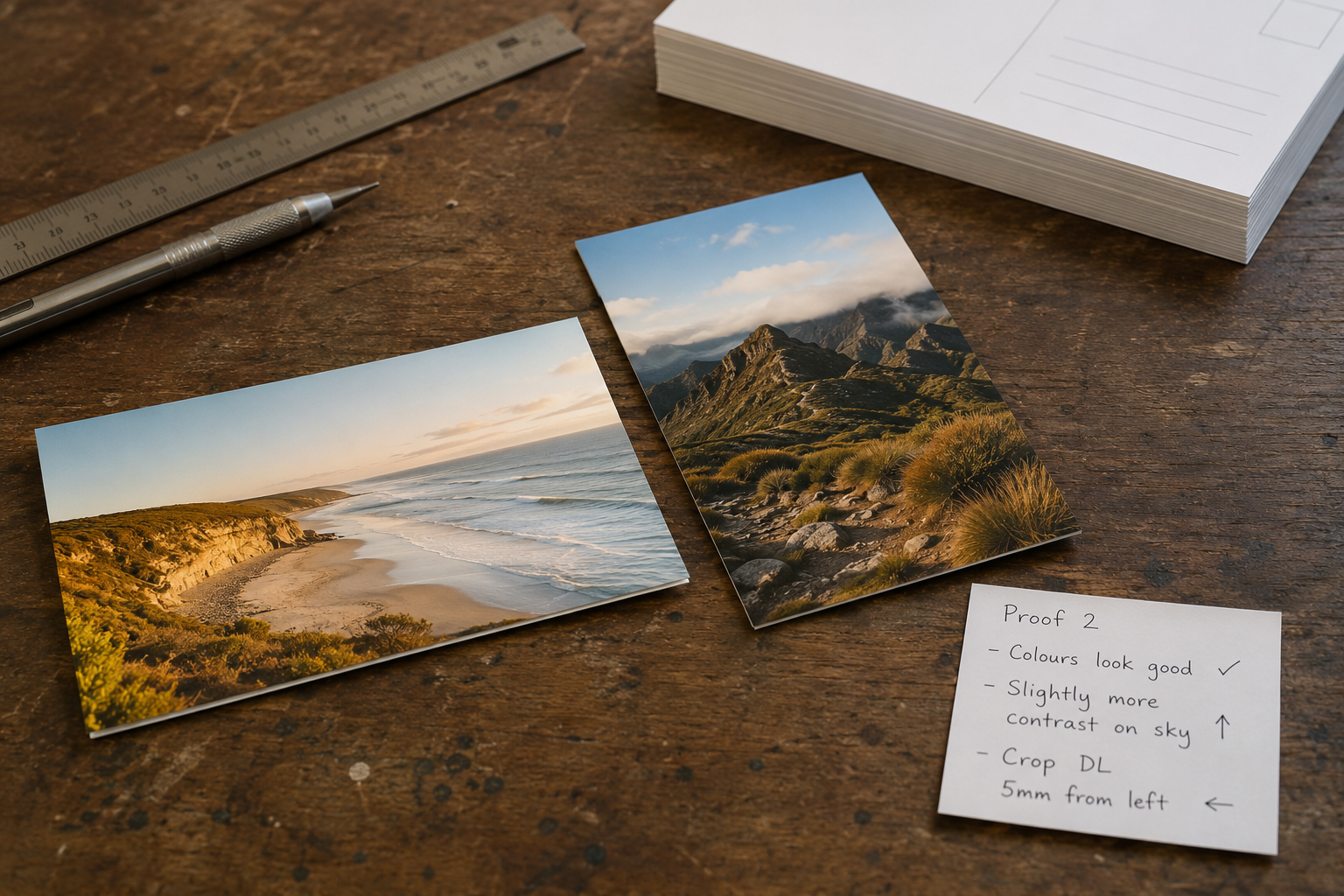
Print limits should shape the design before the final artwork is supplied. A postcard designed only for the screen can create problems once bleed, trim, paper, finish, address layout, QR codes, and readable type are considered.
Small format print leaves little room for mistakes. Fine text can disappear. Low-contrast colours can become hard to read. Important details placed too close to the edge can be trimmed. A QR code that looks acceptable on screen may fail if it is too small or crowded by other design elements.
Before artwork is finalised, the campaign should be checked against these details:
A postcard should usually ask for one clear action. Too many phone numbers, URLs, QR codes, offers, and messages can make a small card feel crowded. If the campaign needs a longer explanation, the postcard should point to a landing page, booking page, phone number, or sales contact rather than carry all the detail itself.
Variable data printing lets each card carry different information. A postcard campaign can use the same design while changing a name, address, coupon code, appointment date, store location, agent details, or customer segment.
This matters when the campaign needs to be tracked, personalised, mailed, or split between audiences. For example, a retailer might print different offer codes for different suburbs. A real estate agency might use different agent details by area. A clinic might print appointment reminders with different dates. A multi-location business might send the same card with different branch details.
Variable data is useful for:
The data file matters as much as the design file. Names, addresses, codes, and segments should be supplied in a clean spreadsheet, with each field separated clearly. A small data problem can become a large print problem if it is not found before production.
A postcard that will be mailed needs a mailhouse plan as well as a print plan. Address layout, postage category, sorting requirements, barcodes, list quality, and lodgement timing can all affect cost and timing.
Campaigns using mailing lists, address data, or postage discounts should be checked before final artwork. Australia Post lists PreSort Letters as an option for more than 300 machine-addressed sorted items, with further discounts available when items are barcoded. Australia Post also lists Promo Post for promotional PreSort letter articles that meet its size, weight, and classification rules.
That does not mean every postcard campaign should use a bulk-mail product. A smaller mailout, local handout, product insert, or appointment card may have a different path. The point is to make the mailing decision before the card is designed around the wrong layout.
List quality is also a production issue. A clean address file reduces wasted print, returned mail, and manual correction time. Campaigns that involve mailing lists, address data, or postage discounts need a mailhouse plan as well as a print plan.
Postcard campaign cost is shaped by design, size, quantity, stock, finish, variable data, mailing, and delivery. A simple handout card and a personalised direct mail postcard may look similar on a desk, but they are different jobs in production.
Short runs may suit digital printing. Higher-volume campaigns may call for a different print method or production sequence. Special finishes can add handling time. Variable data adds setup and checking time. Mailing adds address processing, sorting, and postage planning.
| Cost factor | What affects it |
|---|---|
| Design and artwork | New design, supplied artwork, layout changes, variable data setup |
| Print quantity | Short digital run, larger campaign run, wastage allowance |
| Stock | 350 gsm, 400 gsm, uncoated, matte, gloss |
| Finish | Rounded corners, spot UV, soft touch, special handling |
| Mailing | Addressing, sorting, postage, lodgement, delivery timing |
| Campaign tracking | Unique codes, QR codes, landing pages, segmented offers |
Timing should include artwork approval, proofing, printing, finishing, packing, delivery, and mailhouse work if needed. A postcard that needs to arrive before an event, sale date, auction campaign, or product launch should be planned backwards from the date it needs to be in hand, not only from the date it needs to be printed.
A clear print brief reduces rework. The printer needs enough information to check the job before production, not only a finished PDF.
Send these details before the job is booked:
Draft artwork is useful if the campaign is still being shaped. It gives the printer time to flag bleed, trim, address panel, stock, finish, or QR code issues before the design is approved internally.
A postcard campaign is easier to fix before artwork is final. If a Melbourne business is planning postcards for a promotion, event, customer follow-up, product insert, or mailout, we can check the size, stock, finish, mailing method, and production timing before the job is printed from our Carlton facility.